

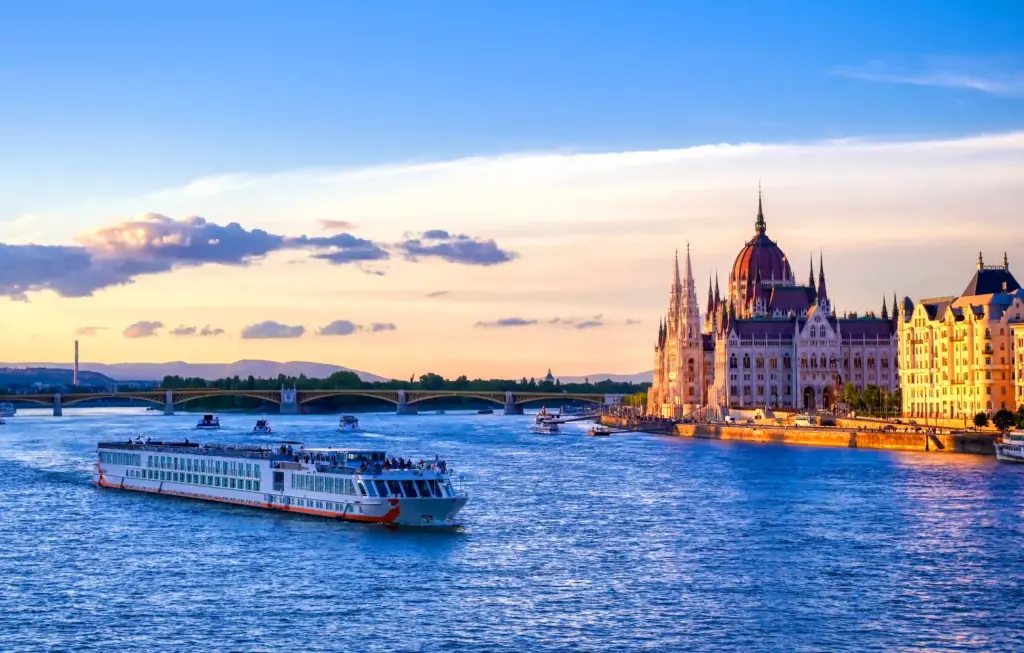
Weeks of extreme heat and minimal rainfall have pushed water levels on the Rhine, Danube and Main below navigable thresholds in several stretches, forcing river cruise operators to swap ships, reroute passengers by coach and shift embarkation points through the peak northern-summer season.
The Danube through Romania has fallen to its lowest level in roughly three decades, according to Reuters, with exposed sandbanks near the Bulgarian border and some ferry services and grain barges idled. Low water is also affecting the Danube through Austria, Slovakia and Budapest and the Regensburg to Passau section have been flagged by operators and parts of the Rhine and Main in Germany. On the Rhine, the Kaub gauge, the commercial shipping chokepoint on the Middle Rhine, sat near 40cm in mid-July, historically low for the period and weeks ahead of the usual low-water season, though still above the 25cm all-time record set in October 2018. French waterways including the Seine and Rhône remain close to normal, and Portugal’s Douro, which is dam-regulated, has reported nothing unusual.

Operators are managing disruption rather than cancelling wholesale. The most common workaround is a “sister ship” swap: passengers coach a short distance around an unnavigable stretch and rejoin an identical vessel positioned on the other side. Uniworld’s S.S. Emilie could not dock at Spitz and rerouted via Linz, skipping Regensburg and Nuremberg. Avalon Waterways shifted the embarkation city on its Legendary Danube itinerary from Nuremberg to Passau and has coached guests between Vienna and Budapest; it is also offering affected passengers the option to switch to a Globus or Cosmos land tour, with a decision deadline of 1 December 2026. AmaWaterways disembarked AmaMagna guests near Budapest, provided hotel accommodation and coached them to Vienna to resume the itinerary. Riviera Travel says it will not cancel any sailings, instead substituting excursions and destinations, with changes across seven vessels on the Rhine, Main and Danube.
The industry’s core advice to travellers and agents is to verify sailing status directly with the operator before travelling to the port, expect the possibility of coach transfers, revised sailing schedules, changed overnight moorings or minor excursion re-timing, and understand that itinerary modifications, not cancellations are the likely outcome for most departures. Operators say affected guests and their travel advisors will be notified directly of anticipated changes. Agents should also flag an insurance gap to clients that low-water itinerary changes are frequently not covered by standard travel insurance.
Some relief may be near-term. Rainfall was forecast across parts of the affected regions from around 20 July, and recent rain had already kept the Rhine above the critical lows of 2018 and 2022. Whether that holds depends on the heat pattern breaking — and with more than 380 river cruise vessels now operating on Europe’s waterways and around 60 more on order, recurring low-water summers are increasingly shaping how the sector plans its operations.